CTRL + ALT + BELIEVE

June 30, 2026 · 19 min read · AI · Technology & Innovation
AI is scary, useful, misunderstood, overhyped, underused, and somehow still just getting started.
Ctrl + Alt + Believe is a small play on Ctrl + Alt + Delete.
That old shortcut feels like the perfect metaphor for where we are right now. As we try to control AI, we find ourselves entering an alternative way of building, thinking, designing, and working. And somewhere in that process, our beliefs start to guard up.
Belief.
Fear.
Trust.
Hope.
Uncertainty.
All sitting in the same room, staring at the same screen.
And honestly, that is where this blog begins.

It has been a while since I last wrote here.
Part of that was life. I took some time for myself, travelled, stepped back, and let things breathe a little. Sometimes you need to get away from the screen to understand what you have been staring at for too long.
But the other part was work.
Not work as in, “I was too busy to write.”
More like work as in, “I was changing direction without fully realizing it.”
I was still in the same world. Still building for the web. Still designing, developing, debugging, fixing, launching, breaking things, fixing them again, and pretending the final bug was definitely the last one.
But I was slowly moving into a different alleyway of the same domain.
For years, my work was mostly about websites, web apps, interfaces, and digital experiences. That is still part of what I do. But lately, I found myself digging deeper into AI, automation, fast prototyping, legacy system integration, and the idea of taking something that already works and making it smarter.
Not replacing everything.
Not throwing the old system in the trash.
More like opening the hood, understanding the engine, and asking:
What can we add here to make this thing run better?
That shift changed how I look at development.

AI did not make me less of a developer. It made me rethink what development can become.
And while I was going deeper into that world, I started noticing something else.
People are becoming afraid of AI.
Not curious.
Not skeptical.
Not careful.
Afraid.
And to be honest, I get it.
AI is weird. AI is powerful. AI is moving fast. AI is entering places we did not expect it to enter this quickly.
It writes.
It codes.
It draws.
It talks.
It summarizes.
It edits.
It answers.
It sometimes lies with confidence, which makes it feel even more human than it should.
So yes, fear makes sense.
But fear alone is not a strategy.
Fear can make us ask good questions, but it can also make us confuse what is possible with what is close, what is dangerous with what is misunderstood, and what is new with what is automatically wrong.

First, what are we even talking about?
Before we go further, let’s clear up the alphabet soup.
Because not everyone lives in this world every day.
And not everyone should be expected to.
Think of this as the small orientation before the real conversation begins. Like opening the hood of a car before trying to understand why the engine sounds different. You do not need to be a mechanic to follow along, but a little context helps you understand what you are looking at, what each part does, and why everyone keeps arguing about where the machine is going.
So, here are the basics.
AI means artificial intelligence.
That is the big umbrella. It can mean a lot of things, from recommendation systems to chatbots, image generators, coding assistants, translation tools, automation systems, and software that helps people make decisions faster.
AGI means artificial general intelligence.
In simple words, AGI would be an AI system that can think, learn, adapt, and solve problems across many areas at a human-like level.
Not just “write me an email.”
More like, “understand the world, learn new skills, reason through complex problems, and move between different domains the way a person can.”
ASI means artificial superintelligence.
That is the next jump. ASI would not only match human intelligence, it would go beyond it.
So, in video game terms:
AI is the tutorial area.
AGI is the final boss people keep warning us about.
ASI is the secret boss people are already making documentaries about before anyone has even unlocked the door.
And that is where things get messy.
Because current AI is real. Very real.
The tools we have today are already changing how people work, learn, design, write, code, sell, create, search, and communicate. The 2026 Stanford AI Index reported major growth in AI adoption and model capabilities, including strong progress in coding benchmarks and broader organizational use of generative AI.
So no, AI is not just hype.
But ASI?
That is still hypothetical.
It may happen.
It may not.
It may take years.
It may take decades.
It may look nothing like what people imagine.
And this is where I think we need to breathe a little.

The flying car problem
ASI reminds me of flying cars.
For decades, flying cars were the future.
They were in movies, magazines, cartoons, predictions, and every conversation about what tomorrow would look like.
The message was always the same:
Soon.
Soon, we would all have flying cars.
Soon, traffic would be solved.
Soon, the sky would be full of everyday people casually flying to work.
And yes, today we do have early air taxis, electric aircraft, and personal flying vehicle experiments. So the idea was not completely ridiculous.
But the version people imagined?
Not here.
Not even close.
Because possible does not mean practical.
Practical does not mean affordable.
Affordable does not mean legal.
Legal does not mean safe.
Safe does not mean normal.
That is how I see ASI.
Is it possible? Maybe.
Is it worth discussing? Yes.
Is it something we should build our entire fear around today? I am not convinced.
Sometimes the future is real, but the timeline is wrong. Sometimes the concept is right, but the final version looks nothing like the fantasy.
And sometimes we are so busy fearing the most extreme version of tomorrow that we miss what is already happening today.
The people trying to control AI

There are people and organizations focused on preventing future AI danger.
One example is ControlAI, an organization focused on artificial superintelligence risk. In Canada, Samuel Buteau has been involved in that conversation and has spoken about AI risk in policy spaces. He also appeared before Canada’s Standing Senate Committee on Human Rights as a Consulting Program Officer for ControlAI, which you can find in the Senate transcript.
I do not think people like this are automatically wrong.
Actually, I think it is useful that some people are thinking far ahead. We need people who look at powerful systems and ask uncomfortable questions.
That is how we got cybersecurity.
That is how we got aviation safety.
That is how we got privacy laws.
That is how we got rules around medicine, transportation, infrastructure, finance, and other things that can hurt people when they go wrong.
But there is a difference between preparing for risk and living inside a prediction.
There is a difference between saying:
Let’s be careful.
And saying:
The monster is already at the door.
Right now, ASI is not at the door.
AI is.
And that is already enough to deal with.
Are guardrails real, or are they just comfort food?
One question I keep asking myself is this:
Are all these AI safety rules, boundaries, policies, and guardrails really protecting us?
Or are they partly there to make us feel safer?
The answer is probably both.
Some AI safety work is real and necessary. If AI is used in healthcare, hiring, law, education, finance, insurance, or government systems, there should absolutely be rules. There should be testing. There should be accountability. There should be limits.
The NIST AI Risk Management Framework exists for that reason. It helps organizations think about AI risk in a structured way instead of just saying “trust us.”
The European Union also built the AI Act around a risk-based approach, meaning not every AI system is treated the same. A harmless tool and a high-risk system should not live under the same level of rules.
That kind of work matters.
But there is also a softer side to safety.
Sometimes “responsible AI” becomes a slogan.
Sometimes it becomes a PDF.
Sometimes it becomes branding.
Sometimes it becomes a way to make chaos look organized.
Some AI safety is like cybersecurity: real, useful, and invisible when it works.
Some AI safety is like insurance: you hope you never need it, but you are happy it exists when things go wrong.
And some AI safety is just humans doing what humans always do when the future feels too big.
We create rules.
We create rituals.
We create committees.
We create words that make the unknown feel smaller.
That does not mean safety is fake.
It means we need to separate real safety from safety theatre.
We have seen this movie before
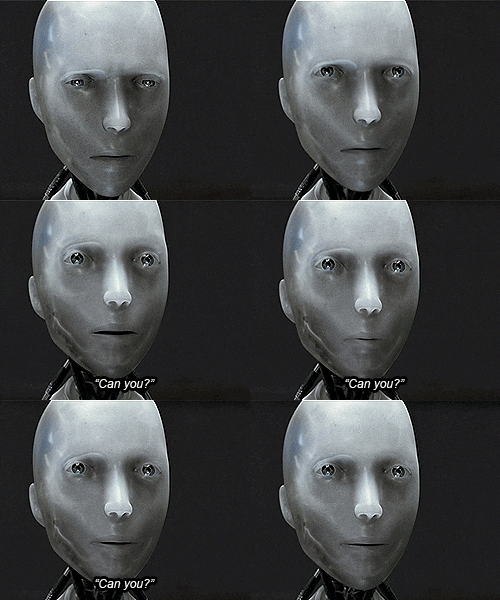
When the internet became mainstream, people were scared too.
They were afraid of viruses, hackers, scams, identity theft, online predators, misinformation, privacy loss, and the idea that people would spend too much time online.
Some of those fears were exaggerated.
Some were completely right.
The internet did create new problems. It also created new industries to solve those problems. Antivirus software, firewalls, encryption, secure payments, identity tools, spam filters, privacy policies, cybersecurity teams, and entire companies were built because the internet opened new doors.
Some doors led to opportunity.
Some led to trouble.
That is usually how technology works.
It gives us power first.
Then we spend years learning how not to burn the house down with it.
AI will probably follow a similar path.
Not one magical company that controls everything.
Not one perfect law.
Not one perfect model.
Not one perfect warning label.
More likely, we will get better models, better tools, better laws, better education, better detection systems, better product design, and hopefully better judgment.
Technology rarely matures through panic.
It matures through use, mistakes, pressure, correction, and time.
But AI is not just “the internet again”
The internet connected us to information.
AI works on information.
That difference matters.
The internet gave people access. AI gives people generation, automation, imitation, prediction, and decision support.
It can write the email.
It can generate the image.
It can summarize the contract.
It can code the feature.
It can fake a voice.
It can create a scam.
It can help someone build something useful.
It can help someone build something harmful.
Same tool.
Different hands.
That is why I do not dismiss AI risk.
I dismiss lazy fear.
There are real concerns:
Fake content.
Copyright issues.
Automated scams.
Bias.
Hallucinations.
Overreliance.
Job disruption.
Creative tension.
Loss of trust in what we see and hear.
Those are serious.
But “AI is bad” is not a serious argument.
It is a reaction.
And reactions are not enough.
The generative AI fight

This is probably the most emotional part of the AI conversation.
Generative AI makes people angry.
Especially artists, designers, writers, photographers, musicians, and creators who feel their work was used without permission, credit, or payment.
And honestly, I understand that anger.
Many AI models were trained on massive datasets collected from the internet. A lot of creators believe their work was used to train systems that can now compete with them. The legal debate is still active, especially around copyright, fair use, training data, and whether AI companies should need permission or licenses. The U.S. Copyright Office has already written about these issues in its report on generative AI training.
So when someone says, “AI steals from creators,” I do not think the answer should be to laugh.
There is something real under that sentence.
But I also think the conversation often becomes too simple.
Every generated image is called theft.
Every AI-assisted edit is called lazy.
Every AI workflow is treated like cheating.
Every person using AI is suddenly accused of replacing real creators.
That does not feel honest either.
People have always learned from references.
Artists study other artists. Designers build moodboards. Developers copy patterns, refactor code, and learn from examples. Photographers study lighting. Musicians are influenced by other musicians. Editors use presets. Designers use templates. Developers use libraries. People remix, rebuild, restyle, reinterpret, and reimagine all the time.
AI did not invent influence.
It automated it.
And that is where the real debate begins.
Because automation changes everything.
If I study a painting and create something inspired by it, that is one thing.
If a machine can generate thousands of images in a recognizable artist’s style in seconds, that is another.
If I use AI to make my own food photo look cleaner, that is one thing.
If a company uses AI to replace an illustrator whose work helped train the system, that is another.
Not everything is theft.
Not everything is fair.
Not everything is inspiration.
Not everything is exploitation.
The details matter.
The “in the style of” problem
A good example is when people ask AI to generate something in the style of a famous artist or studio.
Some people see it as harmless fun.
They are not selling it. They are not pretending they invented the style. They are just experimenting, like someone drawing fan art or editing a photo for fun.
Others see it as disrespectful.
To them, the machine is imitating a visual language that real artists built through years of work, culture, taste, failure, and discipline.
I think both sides make sense.
Inspiration should not become illegal.
But imitation should not be treated like it has no consequences.
There is a difference between learning from a style, playing with a style, copying a style, and commercially exploiting a style.
That difference existed before AI.
AI just made it louder.
AI does not replace taste
Here is the part people forget.
AI can generate.
But generation is not direction.
AI can write something, but it does not know your story unless you give it one.
AI can design something, but it does not know your brand unless someone understands the brand first.
AI can code something, but it does not know your business logic, your users, your technical debt, your future plans, or the weird thing your old system does because someone built it in 2014 and nobody wants to touch it.
AI can create a first version.
It cannot automatically know if that version should exist.
That is still human work.
Taste is human.
Judgment is human.
Context is human.
Responsibility is human.
In my own work, AI is not the author of the vision. It is part of the process.
I might start with a rough idea on paper. Then I think through the structure, the logic, the user flow, the design, the architecture, and the purpose. I might move into Figma. I might write documentation. I might create pseudocode. I might map out how the system should behave.
Then AI can help.
It can scaffold.
It can suggest.
It can review.
It can speed up the boring parts.
It can show me what I missed.
It can give me a base layer to work from.
But after that, it is still editing, testing, debugging, choosing, rejecting, improving, and understanding.
The value is not in pressing generate.
The value is in knowing what should exist, why it should exist, and what to do with it after the first version appears.
That is the difference between using AI and being used by AI.
Eventually, everything becomes normal

Right now, people talk about AI models like they are completely different planets.
OpenAI. Anthropic. Google. Meta. Mistral. Open-source models. Local models. Enterprise models.
Each one has different strengths, personalities, rules, prices, speeds, integrations, and limitations.
But I think the baseline will eventually converge.
At some point, choosing an AI model may feel a bit like choosing a browser.
Chrome, Safari, Edge, Firefox, Brave.
Different interfaces.
Different defaults.
Different ecosystems.
But they all open the same internet.
AI may become similar.
One model may be more creative. Another may be more careful. One may be better for business. One may be better for coding. One may be private. One may be local. One may be cheaper. One may be faster.
But the real competition may not be who has “the smartest chatbot.”
The real competition may be who brings intelligence into real workflows in the most useful, responsible, and human way.
That is where I see the future.
Not replacing people.
Helping people move faster.
Helping businesses modernize.
Helping old systems become smarter.
Helping ideas become prototypes sooner.
Helping teams spend less time repeating and more time thinking.
That is the bright side.
And yes, I do think the bright side matters.
Surf, sink, or swim sideways
I am not saying everyone should blindly jump into AI.
Blind excitement is just fear wearing sunglasses.
There are real problems. Legal problems. Ethical problems. Environmental problems. Creative problems. Job problems. Trust problems.
Anyone who says otherwise is selling something.
But there is also no value in standing still and calling every new tool a threat.
If you do not surf the wave, you drown.
If you swim against it, who knows where you will end up.
The better choice is to learn the water.
Understand the current. Know when to move with it. Know when to resist it. Know when the wave is useful. Know when it is dangerous. Know when to ride it, and know when to get out.
That is how I see AI.
Not as a replacement for humanity.
Not as the end of creativity.
Not as a shortcut to greatness.
And definitely not as magic.
AI is a tool. A powerful one. A messy one. A controversial one. A fast-moving one.
But still a tool.
The question is not whether AI will change things.
It already is.
The real question is how we choose to participate in that change.
With fear?
With denial?
With blind excitement?
Or with intention?
I know which one I choose.
I am not here to worship AI.
I am not here to fear it.
I am here to understand it, use it properly, criticize it when needed, and build with it where it makes sense.
So yes, it has been a while since I wrote here.
But maybe that pause was necessary.
I needed time to understand where I was going.
I am still building for the web. But the web itself is changing. The tools are changing. The speed is changing. The expectations are changing. The way we imagine products is changing.
And I would rather be part of shaping that change than standing outside of it, afraid of what it might become.